Picking the right sealant is more than just looks. It’s key for keeping buildings in good shape and avoiding expensive fixes. Facades move because of temperature, wind, and even the building settling. Sealants fill gaps, but they must handle the movement, or problems pop up.
Focus on sealant choice when using large panels, mixing materials like brick and metal, or dealing with big temperature changes. The best time is before building, but sealant failure during checks should make you rethink your choice.
How do you pick? First, figure out how much the joint will move. Sealant data sheets show movement ability as a percentage (like +/-25%). The joint width must fit this movement. Installers must prep surfaces and apply sealant at the right depth, avoiding too much or too little.
Common errors? Buying cheap sealant to save cash. Ignoring if it works with the surface. Missing thermal expansion differences. Skipping cleaning and priming the joint.
A practical overview of wood window installation with practical tips on sealing, insulation, and alignment..What if things go wrong? Leaks happen. Water wrecks things. Mold grows. Materials fall apart. This leads to costly fixes, like replacing sealant or rebuilding the facade. Choosing and installing sealant right avoids all this.
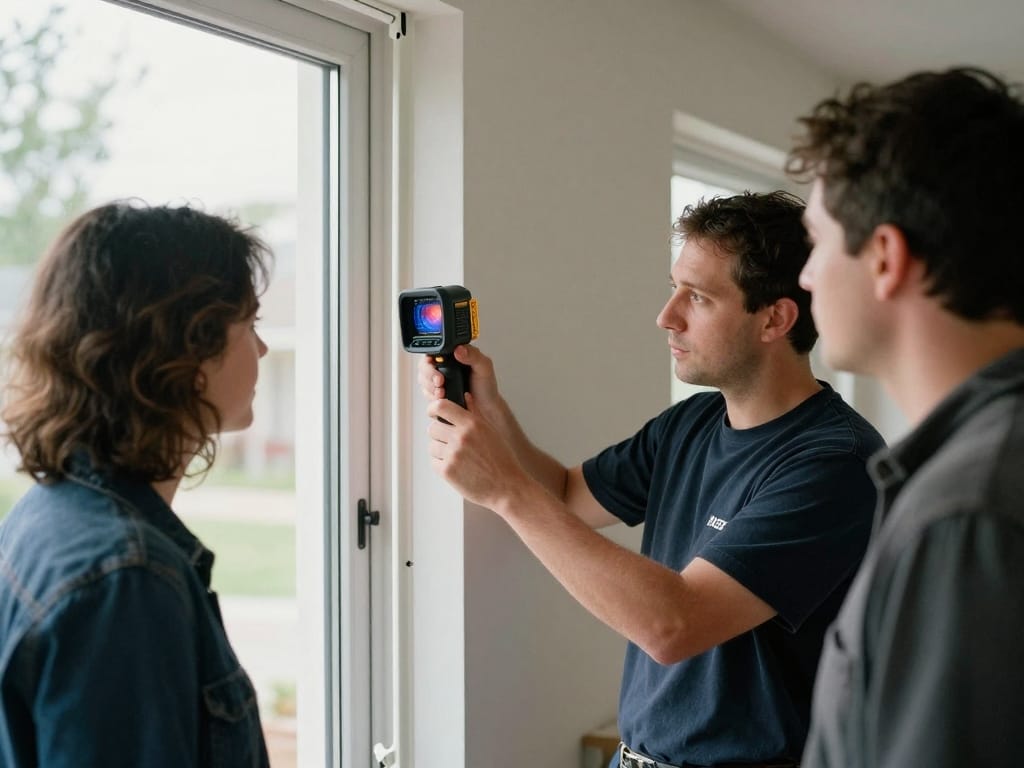
Air leakage detection methods in installed windows

Thermal insulation is the decrease of warmth transfer (i. e., the transfer of thermal energy in between things of varying temperature) between items in thermal get in touch with or in variety of radiative impact. Thermal insulation can be accomplished with specifically crafted approaches or procedures, along with with ideal object forms and products. Warm flow is an inescapable consequence of contact between things of various temperature. Thermal insulation provides a region of insulation in which thermal transmission is decreased, producing a thermal break or thermal obstacle, or radiant heat is shown instead of soaked up by the lower-temperature body. The insulating capacity of a product is gauged as the inverse of thermal conductivity (k). Low thermal conductivity amounts high insulating capability (resistance value). In thermal design, other crucial homes of shielding products are item thickness (ρ& rho;-RRB- and particular heat capacity (c).
.A door is a hinged or otherwise movable obstacle that allows ingress (entry) into and egress (leave) from an enclosure. The produced opening in the wall is an entrance or portal. A door's crucial and main function is to provide safety and security by managing accessibility to the entrance (site). Traditionally, it is a panel that suits the doorway of a building, space, or lorry. Doors are usually made from a product fit to the door's job. They are generally affixed by hinges, but can move by various other ways, such as slides or counterbalancing. The door may have the ability to relocate various ways (at angles away from the doorway/portal, by moving on a plane alongside the structure, by folding in angles on an identical aircraft, or by rotating along an axis at the center of the structure) to enable or protect against access or egress. Most of the times, a door's indoor matches its exterior side. Yet in various other cases (e. g., a vehicle door) both sides are significantly various. Several doors integrate securing mechanisms to make certain that just some individuals can open them (such as with a secret). Doors might have gadgets such as knockers or buzzers through which people outside introduce their presence. In addition to providing accessibility right into and out of an area, doors might have the secondary features of ensuring personal privacy by stopping unwanted interest from outsiders, of separating locations with different functions, of allowing light to enter and out of a space, of regulating air flow or air drafts to make sure that insides may be better warmed or cooled, of wetting sound, and of obstructing the spread of fire. Doors can have visual, symbolic, or ritualistic functions. Getting the secret to a door can indicate a modification in standing from outsider to expert. Doors and doorways regularly show up in literature and the arts with symbolic or allegorical import as a portent of adjustment.
.A wall is a structure and a surface area that specifies a location; carries a lots; gives safety and security, sanctuary, or soundproofing; or serves an attractive objective. There are numerous types of walls, including boundary obstacles between nations, brick wall surfaces, protective wall surfaces in strongholds, and keeping walls that keep back dust, stone, water, or sound. Walls can likewise be discovered in structures, where they sustain roof coverings, floorings, and ceilings, enclose spaces, and give sanctuary and protection. The construction of walls can be categorized right into framed wall surfaces and mass-walls. Mounted wall surfaces move the load to the structure via blog posts, columns, or studs and generally consist of structural components, insulation, and surface components. Mass-walls are constructed from solid materials such as masonry, concrete, adobe, or rammed planet. Wall surfaces might additionally house energies like electric circuitry or pipes and should satisfy neighborhood building and fire codes. Walls have actually traditionally served defensive objectives, with the term "wall surface" originally describing protective wall surfaces and barricades. Examples of well-known protective wall surfaces include the Great Wall of China and Hadrian's Wall. Along with their useful roles, walls can likewise be decorative, adding to the aesthetic allure of a space.
.